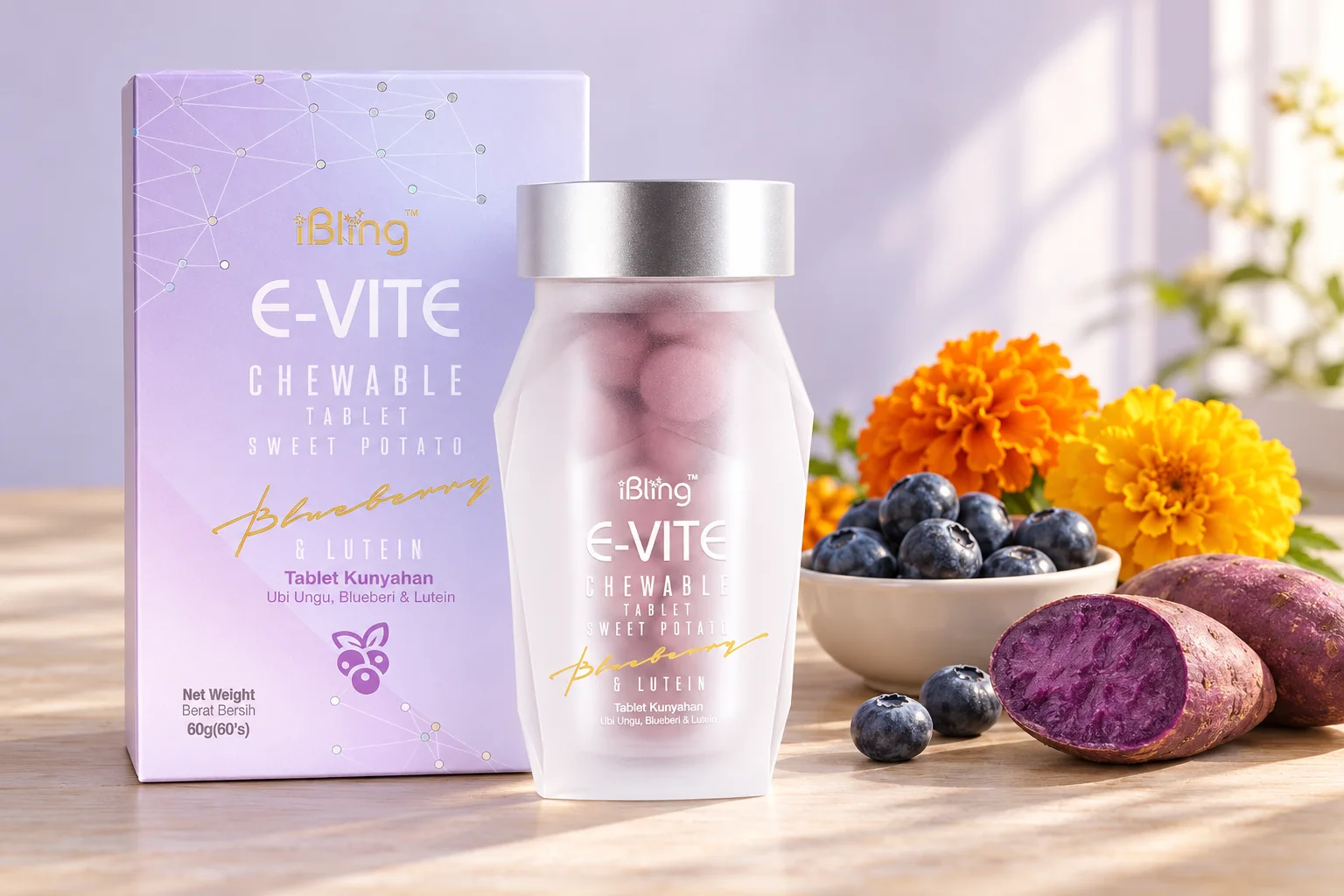
Your body cannot make either one and food rarely gives a steady amount, so people take lutein for screen-tired eyes and to look after their vision with age; the American Optometric Association recommends 10 mg of lutein and 2 mg of zeaxanthin a day. It is not a treatment for any eye disease. If you want both in one chewable, E-VITE gives 10 mg lutein, 2.2 mg zeaxanthin and 4 mg astaxanthin in 2 chewables a day.
We sell an eye chewable in Singapore, so this guide answers the general questions first and then shows where ours fits. It does not replace an eye check: sudden changes in vision, flashes or eye pain need an eye doctor, not a supplement.
See also: TIGROX HOMEGA, fish oil with vitamin K2 and D3 in one softgel a day.
What are lutein and zeaxanthin, and do you need both?
Lutein and zeaxanthin are carotenoids, like beta-carotene, but your body does not turn them into vitamin A. They settle in the macula, the central area of the retina that handles sharp vision, where together they form the macular pigment, which our E-VITE page calls the eye’s internal sunglasses.
They are partners, not rivals: lutein is more plentiful in food and supplements, while zeaxanthin is packed into the very centre of the macula. So on lutein vs zeaxanthin, a good eye formula gives you both, usually with more lutein, as in the 10 mg and 2 mg figure.
What does lutein do for your eyes, and does it actually work?
Lutein filters high-energy blue light and acts as an antioxidant inside the eye. Our page names who takes it: office workers, students and gamers on screens all day, night drivers, people who wear glasses or contact lenses, and adults 40 and above.
Does it work? Lutein builds up in the eye gradually, so it is a daily habit rather than a quick fix. What you notice day to day is more personal, and our page says plainly that results vary from person to person. Be wary of any product that promises to restore vision or replace your glasses: lutein supports the eye, it does not fix a condition.
Can you get enough lutein from food?
Partly. Dark leafy greens, egg yolk, corn and orange peppers carry lutein, but zeaxanthin is scarcer, and your body cannot make either one. Eat your greens either way; a supplement simply makes the daily amount steady if you rarely eat vegetables or eat out most days.

How much lutein per day: 6, 10, 20 or 40 mg?
The common daily figure is 10 mg of lutein with 2 mg of zeaxanthin. You will also see 6 mg, 20 mg and 40 mg products. A higher strength is not automatically better: lutein builds up in the eye gradually, so steady daily intake matters more than a big dose, and you should not go above the label dose unless your eye doctor advises it.
- Take it with food. Lutein dissolves in fat, so it is absorbed best with a meal that contains some fat. E-VITE’s directions are to chew 2 tablets a day, after a meal.
- Give it time. Macular pigment builds over weeks to months. Our page describes eyes feeling fresher and less tired at the screen in weeks 1-2, sharper focus and less glare in weeks 3-4, and comfortable eyes all day by months 2-3.
- Gummies and chewables. Take them after a meal, and keep them away from children: they taste like sweets.
Lutein side effects: the liver, pregnancy and who should check first
At label doses lutein is generally well tolerated; you already eat it in vegetables. Very high carotenoid intake can tint the skin slightly yellow, which fades when intake drops. On lutein and the liver, we cannot give you a safety figure: if you have a liver condition or take long-term medication, ask your doctor first and stay within the label dose.
For E-VITE, our page says: pregnant, breastfeeding or on medication? Ask your doctor first. Stop if any reaction occurs, and keep the bottle out of children’s reach.
How to choose the best lutein supplement
There is no single best brand for everyone, and we do not rank them. Compare labels on these points instead:
- Dose per daily serving: lutein and zeaxanthin both listed in milligrams, near the 10 mg and 2 mg figure.
- Source: most lutein comes from marigold flowers; a named lutein tells you who made it.
- Partners: some formulas add astaxanthin for tired, strained eyes. Bilberry, rich in anthocyanins, does not build macular pigment, so lutein vs bilberry is not either-or.
- Form: softgels carry the lutein in oil; chewables need no water and suit people who dislike swallowing capsules.
- Papers: halal certification if you need it, vegetarian or vegan status (softgel shells are often gelatin), and lab tests for heavy metals.
- Genuine stock: a sealed box; a price far below the usual one can mean old or repacked stock.
Where E-VITE fits
E-VITE is the iBling eye care chewable we sell in Singapore. Every 2 chewables give 10 mg XanMax® lutein, 2.2 mg zeaxanthin and 4 mg astaxanthin to support clearer vision, soothe eye strain and help filter blue light. XanMax® is free-form lutein from marigold flowers. It tastes of purple sweet potato and blueberry, needs no water, is certified halal by JAKIM, suits vegetarians, and lab tests found no arsenic, lead, mercury or cadmium. A bottle of 60 chewables lasts 30 days, and our price is S$109 a bottle, with free express delivery in Singapore, usually 1-3 working days.