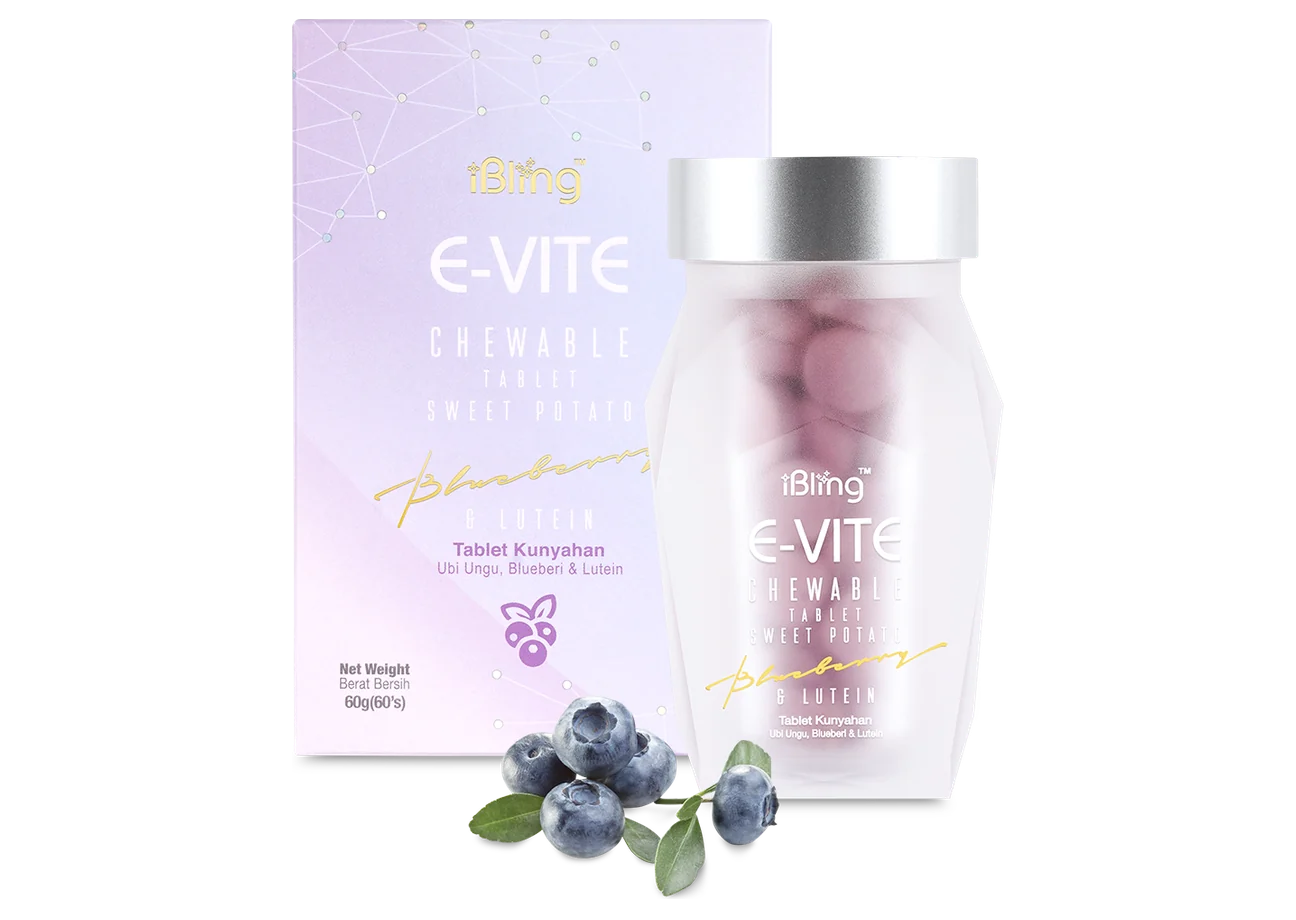
Human research is promising but still small, so think of it as daily support, not a medicine, and follow the dose on your label. In eye formulas astaxanthin is usually paired with lutein and zeaxanthin: every 2 E-VITE chewables give 4 mg astaxanthin with 10 mg XanMax® lutein and 2.2 mg zeaxanthin. Our price is RM260 for a bottle of 60 chewables (30 days): see E-VITE on our Malaysia store.
We sell an eye-care chewable that contains astaxanthin, so this guide answers the general question first and only then shows where our product fits. There are no star ratings or customer quotes here.
See also: BIO Grape Seed Extract, our 95% OPC antioxidant tablet
What is astaxanthin and where does it come from?
Astaxanthin (虾红素 in Chinese) belongs to the carotenoid family, the same group of pigments as beta-carotene, lutein and zeaxanthin. It is made mainly by a freshwater microalga, Haematococcus pluvialis, which turns blood-red under strong sun. Krill and prawns eat the algae, salmon eat the krill, and each stores the pigment, which is why their flesh and shells are pink to red.
Supplements use astaxanthin from farmed microalgae, from yeast, or made synthetically; the label usually says which. It is fat-soluble, so it is absorbed best with a meal.
What are the benefits of astaxanthin?
Astaxanthin is best known as an antioxidant. Its long molecule can sit across a cell membrane, where it helps mop up free radicals, the unstable molecules that sun, pollution and normal metabolism produce. Research has looked at it most in three areas:
- Eyes: small human studies on eye comfort in people who do long hours of screen work, often alongside lutein.
- Skin: skin moisture and elasticity, with modest and mixed results. We make no skin-whitening claims for it.
- General antioxidant support: in active people and in healthy ageing, where the evidence is early.
The honest summary: most studies are small and short, and results vary. Astaxanthin is a reasonable antioxidant to get from food or a supplement, but it is not a medicine for any eye or skin condition; eye pain or sudden blurring needs a doctor.
What happens if I take astaxanthin every day, and how much is typical?
Daily use is how astaxanthin is normally taken: carotenoids build up in the body over weeks, so any difference you notice comes from steady use, not a single capsule. There is no official recommended daily intake for astaxanthin, and labels in Malaysia usually give a few milligrams a day. Follow the label of the product you buy, take it after a meal, and do not stack several products that each contain it.
In E-VITE, 2 chewables a day after a meal give 4 mg astaxanthin, together with 10 mg lutein and 2.2 mg zeaxanthin. No water is needed, and one bottle of 60 lasts 30 days.
Does astaxanthin have side effects?
In the amounts found in supplements, astaxanthin is generally well tolerated in studies. Reported side effects are uncommon and mild, such as stomach discomfort, and very high intakes of carotenoids can give the skin a slight orange tinge. Speak to your doctor first if any of these apply:
- Pregnant, breastfeeding or on medication: ask your doctor first (E-VITE’s own caution says the same).
- Seafood allergy: check whether your product is made from krill rather than algae.
- Any reaction: stop taking it.
What foods are high in astaxanthin?
Only foods from the water carry it in useful amounts: wild salmon (sockeye is the reddest), trout and red sea bream; prawns, crab, lobster and crayfish; krill; and salmon roe and other fish eggs. Farmed salmon gets its astaxanthin from its feed. The amount varies widely with species and cooking, and ordinary plant foods contain almost none.
Why is astaxanthin added to eye supplements with lutein?
Because the three carotenoids do different jobs. Lutein and zeaxanthin gather in the centre of your retina, the macula, as a pigment that filters blue light before it reaches the cells you see with, and your body cannot make either one. Astaxanthin does not build that pigment; it is added as the antioxidant partner, and our E-VITE page says astaxanthin soothes tired, dry, strained eyes. That is why eye-supplement labels so often list lutein, zeaxanthin and astaxanthin together.
E-VITE carries all three in every 2 chewables: 10 mg XanMax® lutein, 2.2 mg zeaxanthin and 4 mg astaxanthin, in a sweet purple sweet potato and blueberry chewable. The American Optometric Association recommends 10 mg of lutein and 2 mg of zeaxanthin a day, so 2 chewables meet both. If you were looking for a softgel that combines these carotenoids with omega-3, note that E-VITE is a chewable tablet, not a softgel.
Astaxanthin vs grape seed extract: how do these antioxidants differ?
Both are antioxidants, but from different families. Astaxanthin is a fat-soluble carotenoid pigment, used mostly in eye and skin formulas. Grape seed extract is rich in OPCs (oligomeric proanthocyanidins), a type of polyphenol; our BIO Grape Seed page explains that OPCs dissolve in both water and fat.
Neither is simply “better”. For screen-tired eyes, an eye formula with lutein, zeaxanthin and astaxanthin is the closer match. For a general antioxidant, BIO Grape Seed gives 50 mg of grape seed extract standardised to 95% OPCs in each tablet, and is KKM registered (MAL19987061T). If you want to take more than one antioxidant supplement, show both labels to your doctor or pharmacist.