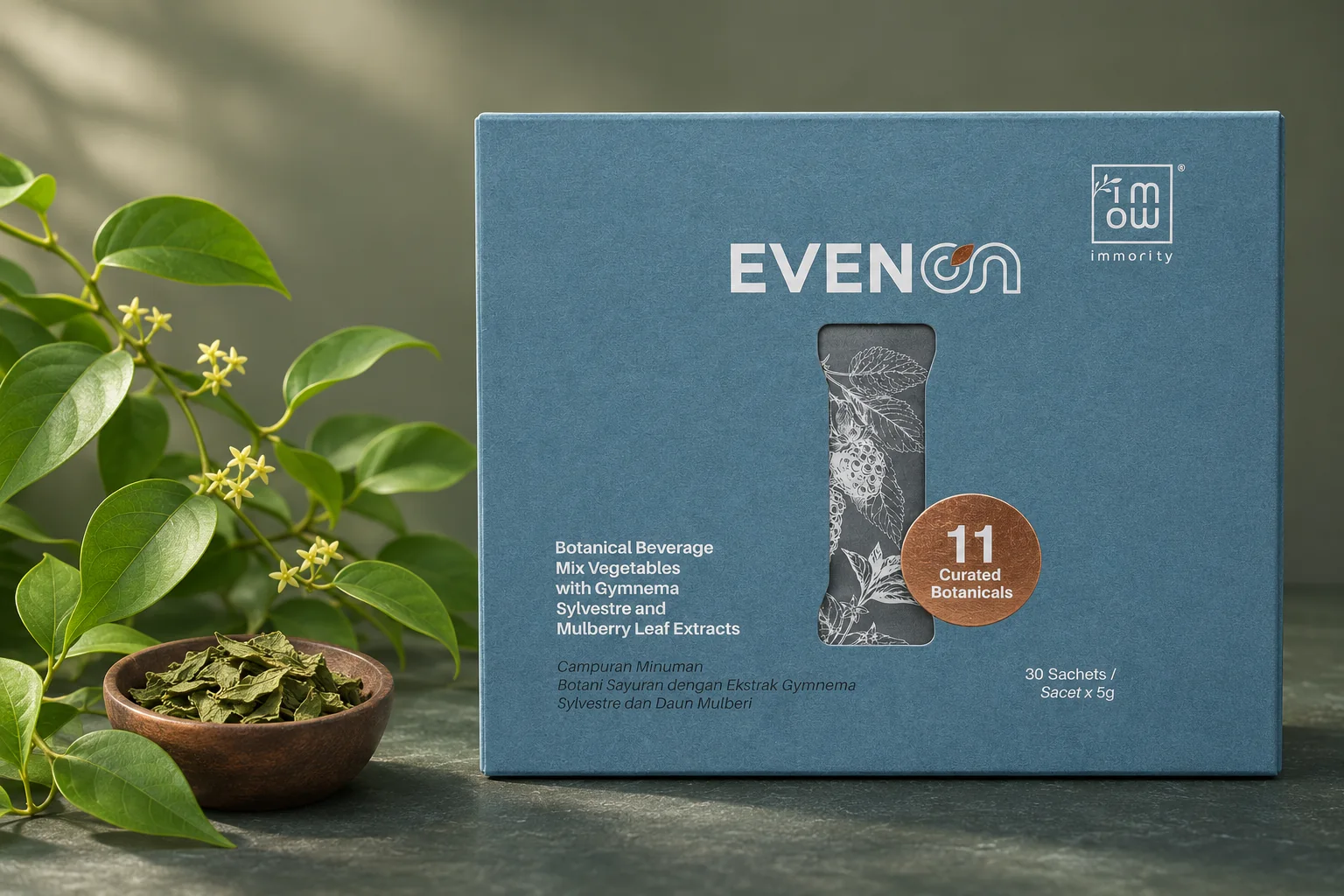
In a human study of gymnema mints, people who ate a lot of sugar cut their daily sugary drinks by 42% after 14 days (Hsiao et al., 2025), and gymnema, with mulberry leaf, leads the 11 botanicals in Immority EvenOn.
Teh tarik, kuih and sweet drinks are part of daily life here, and one in five Malaysian adults has diabetes (International Diabetes Federation, 2021; World Bank, 2026). So a plant that makes sugar less tempting is worth understanding properly. This guide explains what gymnema is, what the studies on it show, how to take it and who should be careful.
Immority EvenOn is a blood sugar balance drink from Immority, a Wellous brand. One 5 g sachet a day, stirred into water with your main meal, gives you 11 botanicals led by gymnema (25% gymnemic acid) and mulberry leaf (5% DNJ). It is halal (JAKIM) and classified as a food product by Malaysia’s NPRA.
See also: How to Stop Sugar Cravings: 9 Practical Steps (Malaysia 2026)
What is gymnema sylvestre?
Gymnema sylvestre is a herb with a long history of traditional use, rooted in Ayurveda, India’s traditional medicine. Its Hindi name, gurmar, means ‘sugar destroyer’. In Malaysia you will also see it searched as daun gurmar, and its Chinese name is 武靴叶.
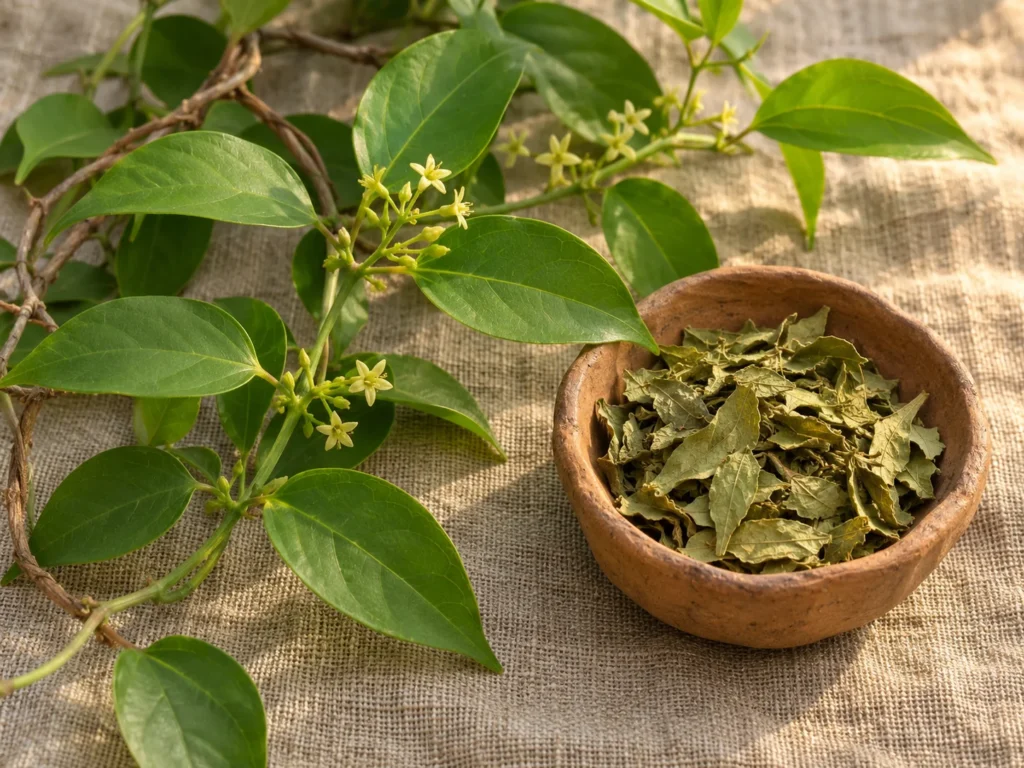
The compounds that act on sweet taste are the gymnemic acids. Gymnema works at both ends of the sugar problem: the brain that wants sugar, and the pancreas that makes insulin. The next two sections take each end in turn.
How does gymnema stop sugar cravings?
Gymnema works on your tongue. Its gymnemic acids briefly dull the sweet receptors, T1R2 and T1R3, so sweet food and sugary drinks register less strongly and the pull towards them eases at the source. The human evidence comes from a study of gymnema mints in people who eat a lot of sugar (Hsiao et al., 2025). It had a placebo group and two gymnema groups, one taking the mints at set times and one taking them freely. After 14 days on the mints, daily intake of sugary drinks was 42% lower, and liking for chocolate, along with the wish to eat more of it, went down (Hsiao et al., 2025). In daily life, that means the teh tarik at 4 pm, the kuih tray at a meeting or the dessert after a mamak dinner pulls at you less.
That makes ‘no’, or ‘just one’, easier to say. It is not a licence to eat unlimited sugar, though. Moderation still matters, and people with diabetes should keep to their own meal plan and keep checking their sugar.
Does gymnema lower blood sugar?
Yes, in human research on gymnema extract. The key study followed adults with type 2 diabetes for 90 days (Kumar et al., 2010).
After 90 days, 2-hour after-meal sugar was 22% lower, fasting sugar 14% lower and the glucose/insulin ratio 34% lower (Kumar et al., 2010). Urine microalbumin, a kidney-related marker, was 37% lower, and HbA1c went from 9.6% to 8.6%, a 1% drop (Kumar et al., 2010).
Three actions beyond the tongue
- Intercepts carbs: it takes up absorption sites in the gut first, so less sugar from your meal gets through.
- Supports insulin release: it wakes tired beta cells to release insulin. Beta cells sit in the pancreas and are the only cells that make and release insulin.
- Eases glucotoxicity: it relieves the oxidative stress that high blood sugar puts on your cells.
Cell studies point the same way. Gymnemic acid regulated Pdx1 and insulin gene expression, which suggests potential to protect beta cells and support their function (Ziyanok-Demirtas & Serin, 2026; Kannan et al., 2022). These were lab studies on cells, not people, and every study in this section tested gymnema extract on its own, not EvenOn.
How much gymnema is in EvenOn, and how do you take it?
EvenOn uses a gymnema extract standardised to 25% gymnemic acid, and the label lists it at 10.0% of the formula. You take it as one 5 g sachet a day with your main meal.
In the sachet, gymnema works with mulberry leaf extract (5% DNJ, 6.0% of the formula on the label): the two slow how starch turns into sugar, so after-meal spikes stay low. Banaba leaf, bitter melon and grape seed complete the five core actives, alongside six greens. Our guide to the 11 botanicals in EvenOn covers each one.
- Tear open one sachet.
- Stir it into 100 to 150 ml of room-temperature water.
- Drink it with the day’s highest-carb main meal: if lunch is nasi lemak or a big plate of rice, take it with lunch.
- Take it at the same meal every day, so it becomes a habit.
One a day is enough; take up to 2 if needed, never more than 2 a day. It has a light green-apple taste, with 16 kcal and 0.3 g total sugars a sachet, and a box of 30 sachets lasts 30 days at one a day. EvenOn is launching soon in Malaysia and the price is announced at launch. For the full picture, see what Immority EvenOn is and who it is for.
Does gymnema have side effects, and who should ask a doctor first?
Gymnema is gentle, with a long history of traditional use, and EvenOn creates no dependence. The main thing to plan for is that your sugar readings may come down, which matters most if you already take diabetes medicine.
Ask your doctor before you start if:
- You take insulin, or tablets that push the pancreas to release insulin, such as sulfonylureas like gliclazide. People on these are most at risk of low blood sugar when anything else lowers their sugar.
- You take any other diabetes medicine, metformin included.
- You are pregnant or breastfeeding.
- You have kidney disease or are on dialysis.
- You have a known allergy. Read the ingredients on the box first, and stop if you feel any discomfort.
On medicine? Keep taking it as prescribed, never stop or change it on your own, and check your sugar more often in the first weeks, because your readings may come down. Know the signs of low blood sugar: shaking, sweating, a fast heartbeat, hunger and confusion. If they appear, check your sugar, follow your doctor’s plan for low sugar and let your doctor know.
As for safety checks, Malaysia’s NPRA classifies EvenOn as a food product, and lab tests show it is free of 408 common drug ingredients, heavy metals and pathogenic microbes. It is made in a GMP, HACCP and MeSTI certified facility.