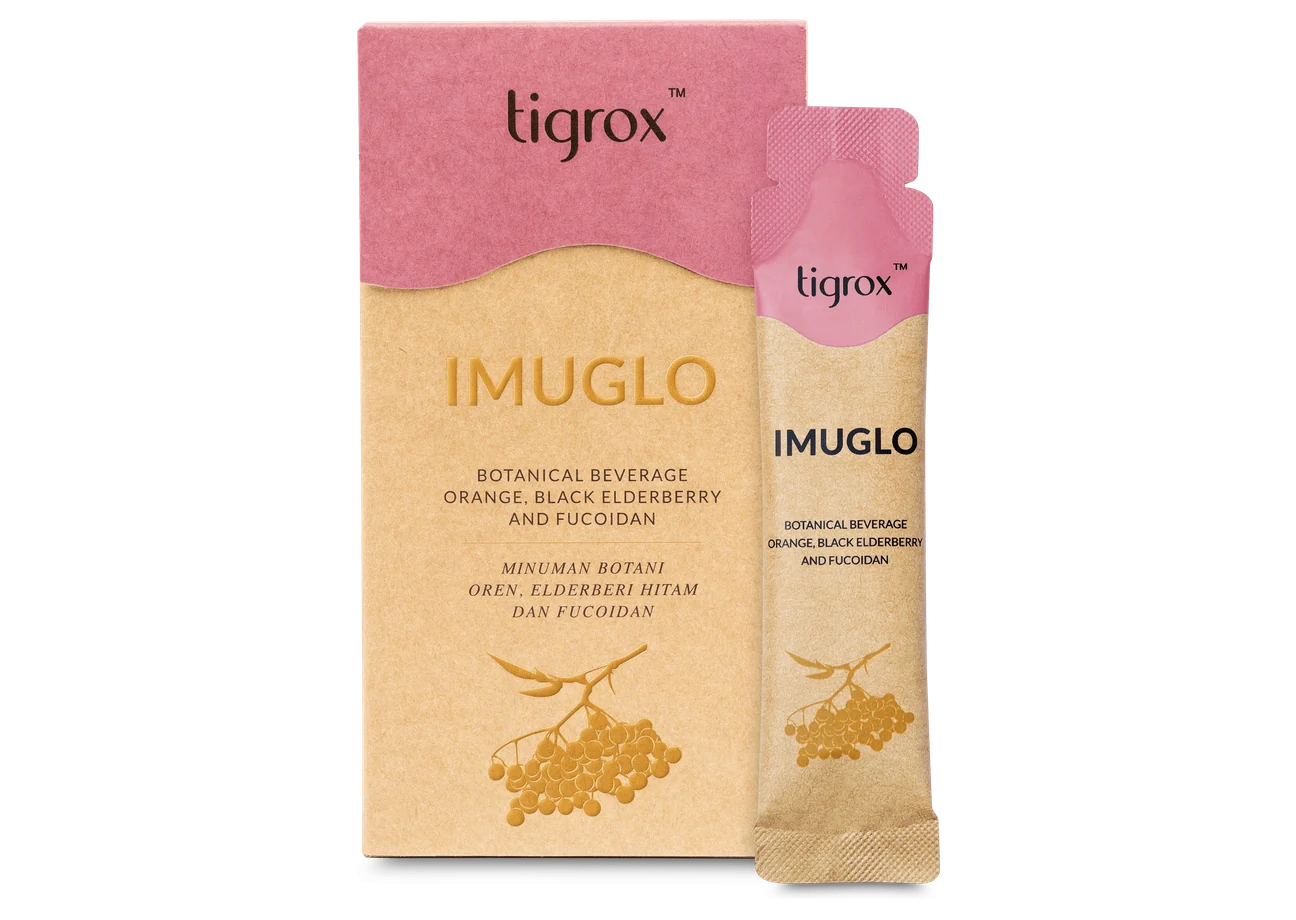
Syrups, gummies and drinks use ripe, processed berries; raw berries, leaves and stems should never be eaten. Elderberry is a food supplement, not a treatment for flu or any illness, so ask a doctor first if you are pregnant, breastfeeding, taking medicine or buying for a young child. If you want a daily elderberry drink, TIGROX IMUGLO gives 300 mg of ElderCraft® European black elderberry per sachet, with maitake, Maritech® fucoidan and PUREWAY-C™ vitamin C.
Here is what elderberry is, what it can and cannot do, how the forms compare and who should be careful. We sell an elderberry drink; where we mention it, we quote only our Malaysia product page.
See also: TIGROX IMUGLO Review (Malaysia 2026): what is in the elderberry drink and who should ask a doctor
What is elderberry, and what is it called in Malay?
Elderberry is the small, dark purple fruit of the elder tree. The species in most supplements is Sambucus nigra, the European black elder, which is why labels say “black elderberry” or simply “black elder”. Its white flowers are sold separately as elderflower, mostly for cordials.
In Bahasa Malaysia the fruit is usually written as elderberi, so a Malay label may read “elderberi hitam” (black elderberry). In Chinese it is 接骨木莓.
What does taking elderberry do for the body?
- It is rich in antioxidants. The deep colour comes from anthocyanins and other polyphenols, plant compounds that help protect cells from everyday oxidative stress. Good extracts are standardised to a set anthocyanin level.
- People take it for immune support. Elderberry has a long traditional use in Europe in the colder months. Today people take it to support their defences when they sleep late, travel or spend days in crowded places.
- The research is promising but limited. Studies on elderberry and seasonal sniffles exist, but most are small and their results are mixed, so be wary of any seller who talks about it like a medicine.
Elderberry is not a medicine and does not replace medical care: a high fever, breathing trouble or symptoms that drag on are reasons to see a doctor.
For example, the ElderCraft® elderberry in IMUGLO is standardised to 14% anthocyanidins, and our product page describes elderberry as supporting upper respiratory wellness.
How do you take elderberry, and is it safe every day?
Elderberry comes in four common forms:
- Syrup: the traditional form; many are sweetened, so check the sugar per spoon.
- Gummies: easy but usually sugary, sometimes made with gelatine, and often lower in extract per piece.
- Capsules or tablets: no sugar, but you swallow a pill.
- Ready-to-drink sachets: a measured serving, no mixing.
Compare the label, not the marketing: the amount of elderberry extract per serving in milligrams, whether it is standardised, the other ingredients, a halal logo, and its KKM status.
Many elderberry products are designed to be taken daily. Long-term research is limited, so stick to the label serving and do not stack several elderberry products. IMUGLO, for instance, is one sachet a day after a meal, drunk straight from the sachet, and our page suggests at least 60 days (3 boxes) alongside good food, enough sleep and exercise.
Elderberry side effects and what not to mix it with
- Never eat raw elder. Raw or unripe berries, seeds, leaves, bark and stems contain compounds that can cause nausea, vomiting and diarrhoea. Commercial products use processed fruit extract.
- Finished products are usually well tolerated, though some people get an upset stomach.
- Ask your doctor first if you are pregnant or breastfeeding, have an autoimmune condition, take medicine that dampens the immune system (for example after a transplant), have a kidney or other long-term condition, or take any regular medicine.
Our IMUGLO page keeps it simple: ask your doctor first if you are pregnant, breastfeeding or taking any medicine. If anything does not agree with you, stop and see your doctor.
Can children take elderberry?
Elderberry products are made for children too, but choose one labelled for your child’s age and follow that label exactly. Ask their doctor first if they take medicine or have allergies, and see a doctor for any fever in a baby.
Our IMUGLO page says children from age 2 drink one sachet a day after a meal, the same as adults, and asks you to keep the box out of reach of young children. If you would rather give a formula made for children, we also carry KidAOne Elderberry + Colostrum.
Why is elderberry combined with vitamin C, beta-glucan or fucoidan?
Formulators pair elderberry with ingredients that support the immune system in different ways: vitamin C, beta-glucans from mushrooms such as maitake, and fucoidan from brown seaweed.
IMUGLO is built this way. Vitamin C is one of four actives: alongside 300 mg of elderberry it adds beta-glucan-rich maitake and fucoidan, which each support your defences in their own way. Our page says maitake supports the immune response and normal intestinal function; the Maritech® fucoidan is from mekabu seaweed, with more than 85% fucoidan as its active compound; and PUREWAY-C™ vitamin C contributes to immune defence and works as an antioxidant. The base is orange juice, cucumber juice and lemon powder. Our price is RM250 for a box of 20 sachets.