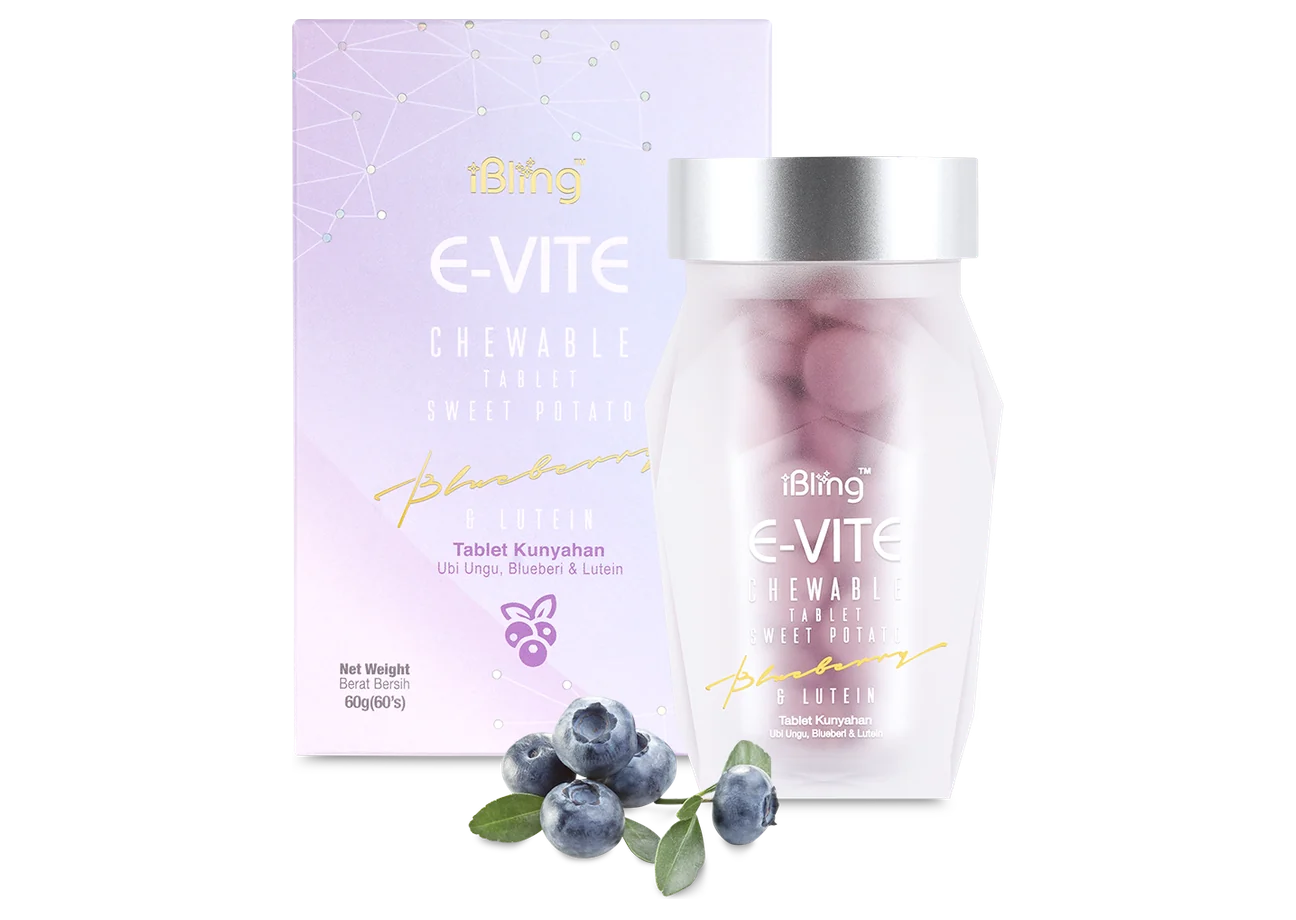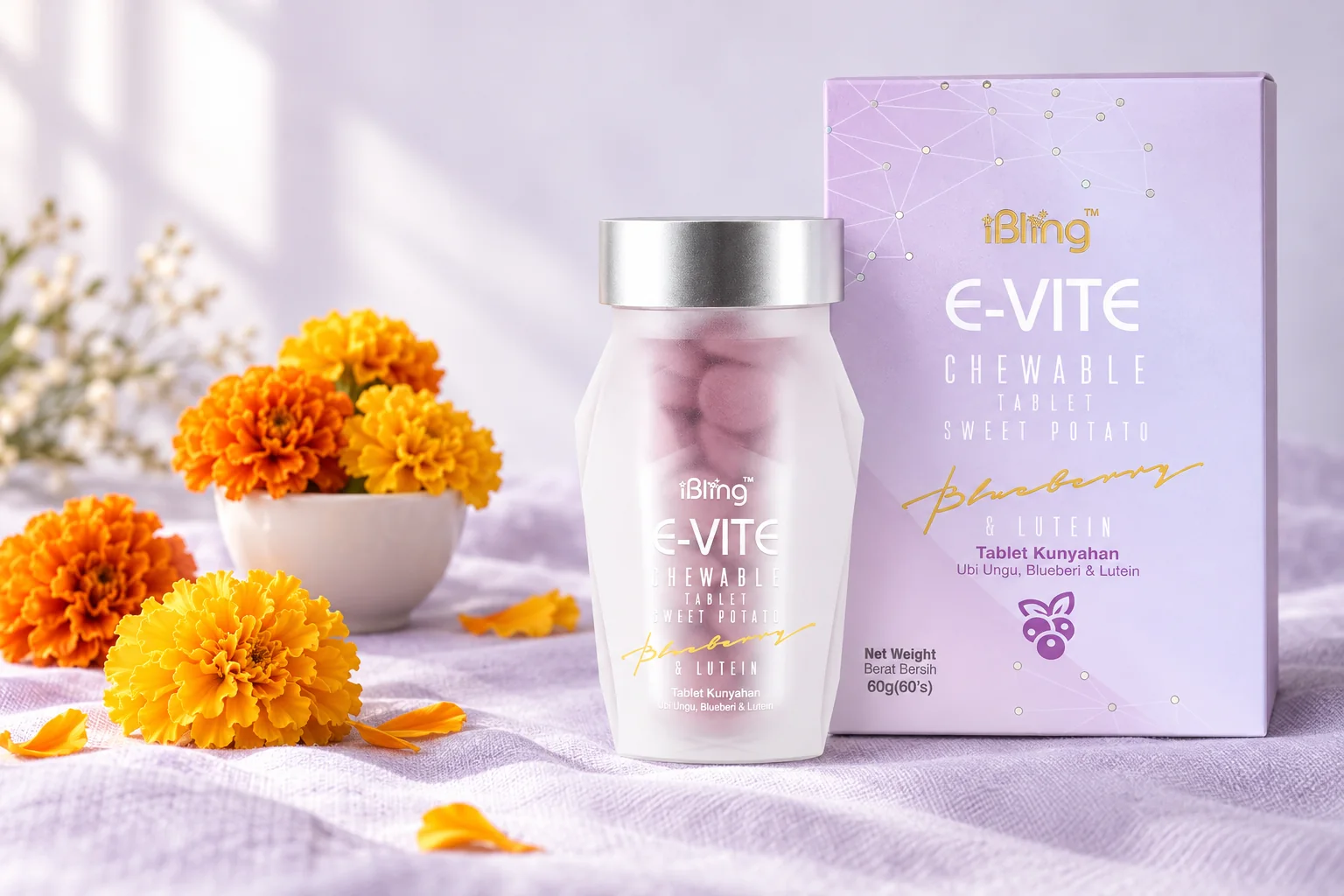
Your body cannot make lutein, so it has to come from food or a supplement. The American Optometric Association recommends 10 mg of lutein and 2 mg of zeaxanthin a day; lutein works slowly, over weeks of daily use, and it supports healthy eyes rather than acting as a medicine. Two E-VITE chewables give 10 mg XanMax® lutein, 2.2 mg zeaxanthin and 4 mg astaxanthin, at our price of RM260 for 60 chewables (30 days): see E-VITE on our Malaysia store.
We sell E-VITE, a lutein eye chewable, so this guide answers the general questions first and then shows where our product fits. There are no star ratings or customer quotes here.
What is lutein and what does it do for the eyes?
Lutein is a carotenoid pigment found in leafy greens, egg yolk, corn and marigold flowers, the usual supplement source. In the eye it gathers in the macula, the spot responsible for sharp, central vision, where with zeaxanthin it forms the macular pigment: a yellow layer that filters blue light before it reaches the cells you see with, the eye’s internal sunglasses. Lutein is also an antioxidant.

Lutein vs zeaxanthin: do you need both?
They are close chemical cousins (“zeaxantin” is a common misspelling of zeaxanthin) and they work as a team. Lutein spreads across the macula, while zeaxanthin is packed at the very centre of your sharp vision. Food gives far more lutein than zeaxanthin, so most eye formulas combine the two in roughly the 10 mg to 2 mg ratio the American Optometric Association uses.
Lutein is not luteolin, a flavonoid from celery and parsley that is not a macular pigment.
How much lutein should I take a day: 10 mg or 20 mg?
The figure most often quoted is the American Optometric Association’s 10 mg of lutein and 2 mg of zeaxanthin a day. Some products sell 20 mg or more, but bigger is not automatically better; do not stack several eye products. If an eye doctor has suggested a specific amount for you, follow their advice. Lutein is fat-soluble, so take it after a meal.
E-VITE keeps it simple: chew 2 tablets a day, after a meal, for 10 mg lutein and 2.2 mg zeaxanthin. No water is needed.
How long does lutein take to work, and does it really work?
Macular pigment builds up slowly, so think in weeks and months, not days. Our E-VITE page sets out what to expect: in weeks 1-2, eyes feel fresher, less tired and dry at the screen; in weeks 3-4 (1 bottle), sharper focus, vision feels clearer and there is less glare; by months 2-3 (3 bottles), eyes stay comfortable all day. Results vary from person to person.
Lutein is one of the most studied eye nutrients, and taking it raises lutein levels in the body over time. But much of the strongest research was done in people under an eye doctor’s care, and a supplement is not a medicine for any eye disease. Blurred vision, eye pain or sudden changes need an optometrist; keep regular eye checks after 40.
Gummies, chewables or capsules: does the format matter?
Less than the packaging suggests. Check the lutein per daily serving (gummies often hold less per piece), whether zeaxanthin is included, the form (free lutein, or lutein esters that the gut must split first), and sugar and halal status. Chewables and gummies suit people who dislike swallowing capsules. E-VITE is a chewable made with free-form lutein from marigold flowers, made small enough to be absorbed straight in the small intestine, and it tastes of purple sweet potato and blueberry.
Who should consider an eye supplement, and what about dry eyes?
Eye supplements are aimed at people whose eyes work hard: office workers, students and gamers on screens all day, night drivers, people who wear glasses or contact lenses, adults 40 and above, and anyone often out in the Malaysian sun.
For dry eyes, lutein’s main job is the macular pigment; in E-VITE, the astaxanthin is there to soothe tired, dry, strained eyes. Blink fully, rest your eyes every 20 minutes, and have lasting or stinging dryness checked by an optometrist.
How to choose an eye supplement in Malaysia
We will not rank brands, but a good lutein supplement passes these checks:
- Dose: about 10 mg lutein with about 2 mg zeaxanthin per day.
- Extras with a reason: astaxanthin, or berries such as blueberry.
- Halal: a JAKIM certificate, since capsule shells can be gelatin.
- KKM status: either a MAL number or an NPRA food classification; a good seller can show you which.
- Lab tests for heavy metals and microbes.
- Sealed, genuine stock: prices far below normal can mean old or repacked stock.
How E-VITE measures up: the doses above, certified halal by JAKIM, classified by NPRA as a food product, and tested by Bio Synergy Laboratories, with arsenic, lead, mercury and cadmium not detected.
Lutein side effects: who should ask a doctor first?
Lutein is generally well tolerated in studies; very high intakes over a long time can tint the skin slightly yellow, which fades when you cut back. If you take several supplements with carotenoids, show your pharmacist the labels. E-VITE’s own caution: pregnant, breastfeeding or on medication, ask your doctor first, and stop if any reaction occurs.